
Your AC ran fine all spring. Now the first real heat wave has arrived. Your AC is blowing warm air or struggling to keep up. Summer turns small problems into full breakdowns. In Bucks County, July humidity can make a 90-degree day feel like 100. A failing system is more than a comfort issue.
Quick Answer: Your AC may need a professional diagnosis. Signs include the house not cooling below 78 to 80°F. Unusual noises and higher energy bills are also warning signs. A tune-up handles maintenance. A repair addresses mechanical or refrigerant failures.
How to Tell If Your AC Needs Repair or Just a Tune-Up
The answer depends on what the system is actually doing, not just how old it is.
The AC runs but the house stays warm. Sometimes the system cycles normally but the temperature won’t drop. The most likely causes are a refrigerant leak, a failing compressor, or a clogged evaporator coil. A tune-up cleans and inspects. It does not restore refrigerant charge or replace worn parts. Air that feels barely cool from your vents is a sign you need a diagnostic call.
Short cycling and unusual noises. Short cycling means your system turns on and shuts off quickly. It never finishes a full cooling cycle. This strains the compressor. It also raises your electric bill. Grinding, rattling, or hissing sounds are repair flags. Hissing often points to a refrigerant leak. The U.S. Department of Energy says proper refrigerant charge is critical to AC efficiency.
Weak airflow from vents. Some rooms may feel much warmer than others. You might hold your hand near a supply vent and barely feel any air. This could mean a blower motor issue, a duct problem, or a severely clogged filter. Homes near Tyler State Park in Newtown Township often have older duct systems. You should have those inspected every few years. Filter and coil cleaning is a tune-up item. A failing blower motor or separated duct is a repair.
When Water Pooling Signals a Repair Call
Water pooling around the indoor unit. Some condensation is normal. But standing water near your air handler is a problem. It usually means the condensate drain line is clogged. The drain pan may also be cracked. Left alone, this can cause water damage. Mold can grow too. A maintenance visit can catch a slow-draining line early. Once water is pooling, you need a repair call.
What Happens When You Delay a Repair Through a Hot Summer
Putting off a repair call when the system is still technically running is a common mistake. AC failures rarely stay small once summer heat is fully underway.
Compressor damage gets expensive fast. The compressor is the most expensive single part in a central air system. Low refrigerant, a dirty condenser coil, and a weak capacitor all put stress on it. A capacitor replacement is a straightforward repair. A compressor replacement is a major job. Depending on the age of your system, it may make more sense to replace the whole unit instead.
Energy bills climb without explanation. A struggling system runs longer to reach your thermostat setpoint. Check your PECO bill against the same month last year. If it jumped and your thermostat habits did not change, your system is working too hard. The U.S. Department of Energy says an inefficient AC can use up to 50 percent more energy. That is compared to a properly maintained system of the same size.
A breakdown during peak heat is harder to schedule. Service demand in Newtown Borough and along the Route 332 corridor peaks in late June and July. Waiting until your system fully fails means competing with every other homeowner in the same spot. Scheduling a diagnostic call at the first sign of trouble almost always means faster service. It usually means a less expensive repair, too.
Common AC Problems in Older Doylestown-Area Homes
Homes in Doylestown, Newtown Township, and the neighborhoods surrounding Tyler State Park vary widely in age and construction. Many were built between the 1970s and 1990s. The HVAC systems in those homes have specific failure patterns worth knowing.
Refrigerant leaks in aging copper lines. Older systems often use R-22 refrigerant. The EPA has phased out R-22 under federal regulations. If your system is more than 15 years old, a refrigerant recharge is costly. R-22 supply is limited, so prices are high. You can review the EPA’s refrigerant phaseout guidelines for background on older refrigerant costs. Adding refrigerant without fixing the leak is not a permanent solution.
Capacitor and contactor failures. Capacitors and contactors are electrical parts that start and run the compressor and fan motors. They wear out over time, especially in systems that run hard through hot summers. A failed run capacitor is one of the most common AC repair calls in this area. It is one of the more straightforward repairs. But a system running on a weak capacitor is slowly damaging the motor it supports. Catching it early matters.
Evaporator Coil Freeze-Ups in Aging Air Handlers
Evaporator coil freeze-ups. If you’ve seen ice forming on the indoor unit or copper lines, the evaporator coil has frozen. This happens when airflow is restricted by a dirty filter or blocked vents, or when refrigerant is low. A frozen coil shuts down cooling entirely until it thaws and can cause water damage in the process. This is a recurring problem in homes with older air handlers that haven’t had consistent maintenance. Our AC repair service includes coil inspection and cleaning as part of every diagnostic visit.
How a Professional AC Repair Visit Works: Diagnosis to Fix
A lot of homeowners aren’t sure what actually happens when a technician arrives. Here’s a straightforward breakdown.
What the Technician Checks First
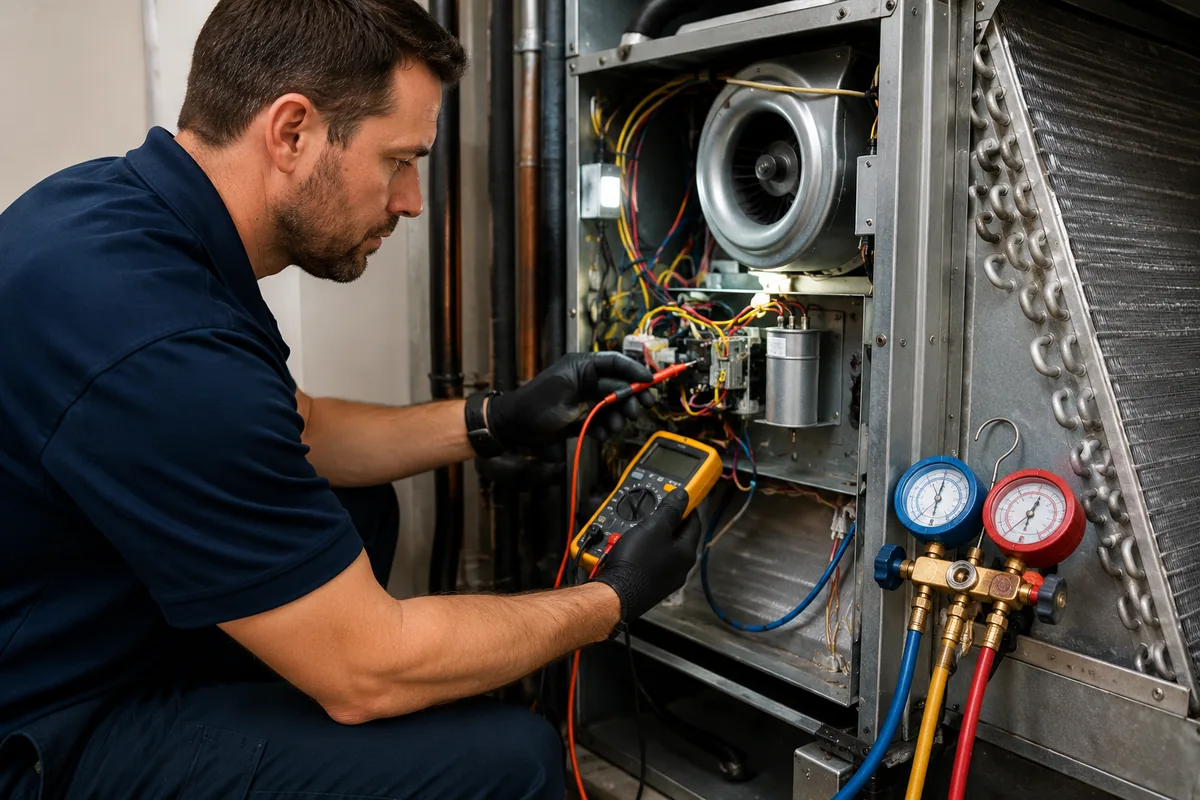
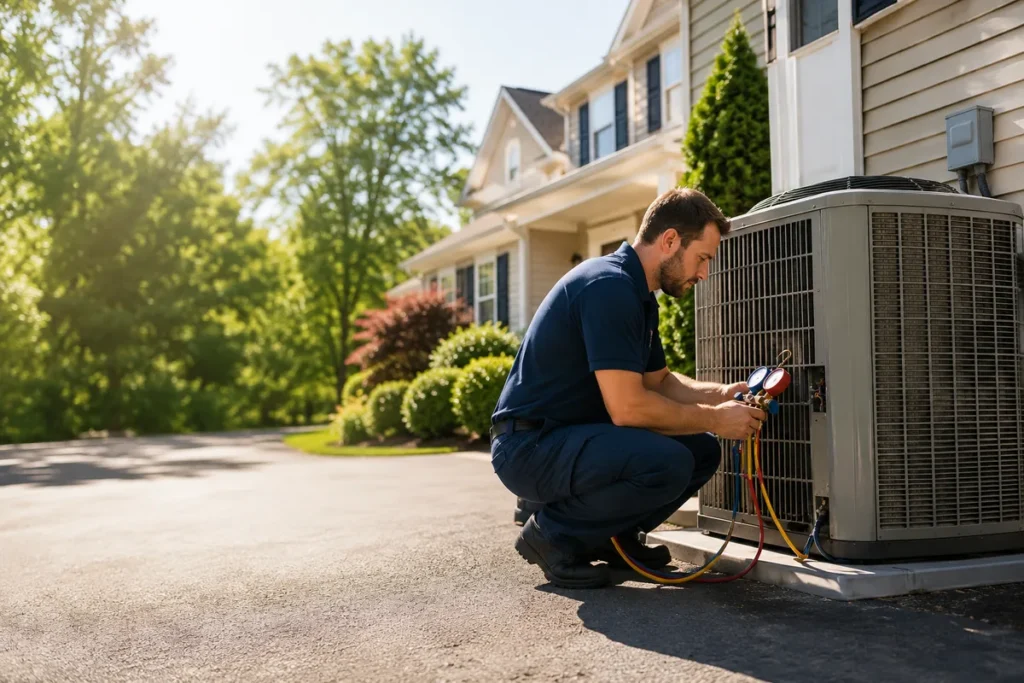
The diagnostic process. The technician starts with a system check. They look at thermostat operation, filter condition, and airflow at the vents. They also inspect the indoor air handler and the outdoor condenser unit. Next, they run electrical checks on the capacitor, contactor, and motors. They measure refrigerant pressure with gauges. This typically takes 30 to 60 minutes. Technicians follow a structured diagnostic protocol. They do not guess at parts. Service First has been PA-licensed since 2009. They serve Newtown Township, Doylestown, Warminster, Richboro, Southampton, and Yardley.
Common Same-Day Repairs and Post-Fix Testing
The repair and parts. Once the cause is identified, the technician explains what is needed before any work begins. Common same-day repairs include capacitor replacement, contactor replacement, condensate drain clearing, and refrigerant recharge after leak repair.
Post-repair testing. After the repair, the technician runs the system through a full cooling cycle. This confirms the fix is holding. They check supply and return air temperatures. They verify refrigerant pressures are within specification. They also confirm the system is cycling correctly. If you are enrolled in an HVAC maintenance plan, this visit counts toward your annual service record.
When Repair Makes Sense and When Replacement Does
AC repair costs vary based on the type of failure, the age of the system, and parts availability. No company should quote a price without diagnosing the system first.
Labor, parts, and refrigerant are the three main cost factors. A capacitor swap is a quick repair with an inexpensive part. A refrigerant recharge involves the refrigerant itself and labor to find and fix the leak. Compressor replacement is the most expensive single repair. It is often the point where replacement becomes the smarter financial decision. Get an instant HVAC estimate before committing to anything.
Using the 5,000 Rule to Decide
A common benchmark is the 5,000 rule. Multiply the system’s age by the repair cost. If that number tops the cost of a new system, think about replacing it. A 12-year-old system often makes more sense to replace. Factor in efficiency gains when you make that call. Modern systems carry SEER2 ratings of 15 or higher. Systems from the early 2000s often run at SEER 10 or below. According to ENERGY STAR, upgrading can cut cooling energy use by 20 to 40 percent. If replacement is the right call, you can learn about our AC installation service. It covers everything from equipment selection to commissioning.
Older ductwork or larger homes can add complexity to the job. That complexity can affect the final cost. A diagnostic visit lets the technician give you a specific number based on your system.
Is your AC struggling this summer? A diagnostic visit tells you what is wrong fast. Call Service First HVAC or schedule online. They serve Newtown and all of Bucks County. You will get a straight answer on repair versus replacement before any work starts.
Frequently Asked Questions
How long does a typical AC repair take from start to finish?
Most standard AC repairs are completed in a single visit of one to three hours. The diagnostic portion takes 30 to 60 minutes, and common repairs like capacitor replacement, contactor swap, or condensate drain clearing are usually done the same day. If a part needs to be ordered, a follow-up visit is scheduled as quickly as possible, typically within one to two business days.
Is it worth repairing an air conditioner that's more than 10 years old?
It depends on the type of repair and the overall condition of the system. Minor repairs like a capacitor or contactor replacement are usually worth doing even on a 10 to 12-year-old system. Major repairs like compressor replacement on a system that age often tip the math toward replacement, especially when you factor in the efficiency gains from a modern unit. A technician can give you a clear cost comparison after diagnosing the system.
Why does my AC run constantly but never cool the house down?
The most common causes are low refrigerant due to a leak, a dirty or frozen evaporator coil, or a failing compressor that can’t build adequate pressure. It can also happen when the system is undersized for the home or when ductwork is leaking conditioned air into unconditioned spaces like an attic. A diagnostic visit will identify which issue is driving the problem so it can be fixed correctly.
Can a refrigerant leak make my family sick?
Modern refrigerants like R-410A are not acutely toxic at typical residential exposure levels, but a significant leak in an enclosed space can displace oxygen and cause dizziness or discomfort. More practically, a refrigerant leak means your system is not cooling effectively, which creates its own health risk during extreme heat. If you smell something chemical near your air handler or notice frost on the refrigerant lines, call a technician promptly.
How do I know if my AC problem is the indoor unit or the outdoor unit?
Weak airflow and ice formation usually point to the indoor air handler or evaporator coil. Warm air from vents despite the system running often indicates a problem with the outdoor condenser or compressor. A hissing sound can come from either unit if refrigerant is leaking. The fastest way to know for certain is a professional diagnostic that checks both units and measures system pressures.
What should I check before calling for an AC repair?
Start with the air filter, a completely clogged filter can cause the system to freeze up or lose airflow entirely. Check that the thermostat is set to cool and the fan is set to auto, not on. Look at the circuit breaker panel to see if the AC breaker has tripped. Check that the outdoor unit is not blocked by debris or overgrown vegetation.