
Summer energy bills in Doylestown and along the Route 202 corridor can climb fast. This happens once temperatures push past 85 degrees. Your AC starts running in long, back-to-back cycles. Most of what drives up your cooling costs is fixable. A lot of it starts with habits and settings, not equipment failure. Lowering your AC energy bill comes down to smarter thermostat use and basic maintenance. Understanding how regional humidity affects your system also helps.
Quick Answer: Set your thermostat to 78°F when home and 85°F when away. Replace your air filter every 30 days during peak cooling season. Schedule a professional AC tune-up before July. These three steps alone can reduce your cooling costs by up to 10, 15%, according to ENERGY STAR.
How Your Thermostat Settings Are Quietly Driving Up Your Summer Bill
Most homeowners set their thermostat once in June and forget it. That works fine in mild weather. It gets expensive once July heat settles in across Newtown and the surrounding townships. The thermostat is the single most controllable variable in your cooling costs. Small adjustments add up to real savings over a full summer.
The 78-Degree Rule and Why It Works
The U.S. Department of Energy recommends 78°F for cooling efficiency when you are home. For every degree you lower the thermostat below that, your system works roughly 3% harder. That translates directly to higher energy use. If you are running at 72°F all day, you are spending more than you need to. Most people do not notice the difference after the first hour anyway.
Programmable and Smart Thermostat Savings
A programmable thermostat lets you set back your system while you work. It can cool your home before you return. Smart thermostats go further. They learn your schedule and adjust on their own. The Department of Energy estimates correct use can save up to 10% per year on heating and cooling. If you have an older manual thermostat, upgrading is a cost-effective move. Consider doing it before peak season.
Avoid the All-Day Blast Habit
Running your AC at full blast all day is less efficient than holding a steady, slightly higher temperature. Your system is built to maintain a set point. It is not built to recover from extreme heat buildup. If your home gets very warm during the day, try blackout curtains or cellular shades. Put them on south and west-facing windows to cut solar heat gain before it becomes your AC’s problem.
Which AC Maintenance Tasks Actually Cut Cooling Costs Before Peak Heat Hits
A neglected AC system works harder than it needs to. That extra effort shows up on your utility bill every month. Most maintenance tasks that improve efficiency are simple and inexpensive. Many do not require a service call.
Change the Air Filter on Schedule
A clogged air filter is a common reason AC systems lose efficiency. It makes your system run longer to cool your home. During peak cooling season, replace your filter every 30 days if you have pets or allergy sufferers. Otherwise, replace it at least every 45 days. A MERV 8 or MERV 11 filter gives you a good balance of air quality and airflow. MERV 13 filters capture more particles. But they can restrict airflow in older systems. Check your equipment manual before you upgrade to one.
Clear the Outdoor Condenser Unit
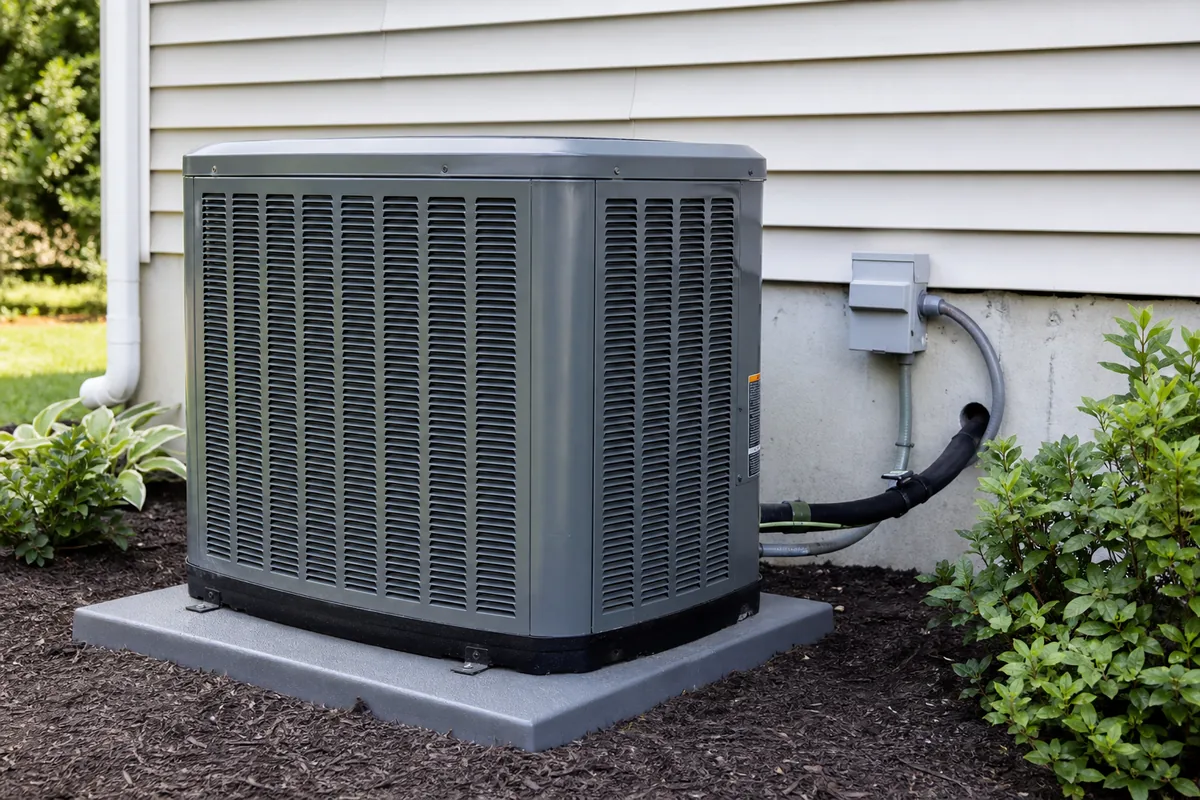
Your outdoor condenser needs at least 18 to 24 inches of clearance on all sides. This space lets it exhaust heat properly. Grass, weeds, and shrubs that crowd the unit force it to work harder. They can also cause the system to overheat. Before the season starts, trim back any vegetation. Remove debris from the top and sides of the unit. Gently rinse the fins with a garden hose if they are visibly dirty. Do not use a pressure washer. The fins bend easily, and bent fins reduce airflow.
Check the Condensate Drain Line
Your AC pulls humidity out of the air. That moisture drains through a condensate line. If the line clogs with algae or debris, water backs up. It fills the drain pan. Some systems will shut down as a safety measure. A clogged drain line is a common summer problem. It comes up often in Warminster and Southampton. You can help prevent it. Pour a cup of distilled white vinegar into the drain line. Do this once a month during cooling season. It helps keep the line clear.
Schedule a Professional AC Tune-Up
A technician can catch issues you cannot, including low refrigerant charge, failing capacitors, and duct leaks. Those leaks waste conditioned air before it reaches your living space. Our AC Tune-Up Special covers a full system inspection, coil cleaning, refrigerant check, and electrical component testing. Check current pricing with our Pricing Tool. A system running at peak efficiency uses less energy to maintain the same comfort level. That difference adds up across an entire summer.
How Bucks County's Humidity Makes Your AC Work Harder Than It Should
Bucks County summers are not just hot, they are also humid. That combination is harder on your AC than dry heat alone. It is one reason cooling bills here can run higher than national averages. Knowing how humidity affects your system helps you make smarter choices about comfort and efficiency.
Why High Humidity Increases Cooling Load
Your AC does two jobs at once: it removes heat and it removes moisture. Outdoor humidity is routinely high in July and August along the Delaware River corridor near New Hope. When that happens, your system has to work harder on the dehumidification side before you even feel cooler. The result is longer run times and higher energy use, even when your thermostat reading looks fine.
The Feels-Like Problem
Humidity raises the apparent temperature. That is why 85°F at 80% relative humidity feels much hotter than 85°F at 50%. If you keep lowering your thermostat but still feel warm, humidity may be the real problem. A system that is undersized, poorly maintained, or low on refrigerant charge struggles to remove moisture. The result is a home that never quite feels comfortable, no matter how low you set the temperature.
How Dehumidification Affects Your Bill
Your home may feel clammy even with the AC on. A whole-home dehumidifier can help with that. It connects directly to your HVAC system. It reduces the moisture load on your AC. That lets your air conditioner cycle off sooner. Cycling off sooner lowers your energy use. It also means your equipment runs fewer hours each day. Running less helps your system last longer. Older homes near Doylestown often have less-than-ideal insulation. If you live in one, this can improve your comfort. It may also lower your monthly costs.
What to Check in Your Home Before Turning the AC On for the Season
Before switching to cooling mode each summer, check your home first. A quick walkthrough can catch small problems early. This takes about 20 minutes. You need no tools.
Check Every Supply and Return Vent
Walk through each room and check that supply vents are open and clear. Furniture, rugs, and curtains can block vents and force your system to work harder. Return air vents matter just as much. These are usually larger grilles in hallways or central areas. They need clear airflow to pull air back to the air handler. Blocked returns are a leading cause of uneven cooling and pressure imbalance in two-story homes.
Inspect the Area Around the Air Handler
Check the area around your air handler. Make sure it is clear of clutter. Look at the drain pan beneath the unit. It should be dry. Standing water in the drain pan means the condensate drain may already be partially blocked. Check the access panel too. It should be fully closed. A loose panel lets unconditioned air into the system. That can lower efficiency and sometimes trigger safety shutoffs.
Test the Thermostat Before Peak Heat Arrives
Set your thermostat to cooling mode and lower the set point five degrees below the current room temperature. Your system should start within a few minutes. If it does not respond, check the circuit breaker for the air handler and outdoor unit. If both breakers are on and the system still will not start, call for service before temperatures climb. Our AC repair services are available throughout the region. Early-season calls get faster response times than mid-July emergency calls.
When to Schedule a Pre-Summer Tune-Up Before Technicians Book Out
Late May to mid-June is the best time to schedule an AC tune-up in this region. Once temperatures consistently hit the upper 80s, HVAC companies fill up fast. Wait times for non-emergency appointments can stretch to a week or more.
Why Early Scheduling Matters
A tune-up in May or early June lets a technician find and fix problems early. Parts are easier to get then, and schedules are more open. A failing capacitor or refrigerant leak found in May can be fixed before summer. That is better than a full shutdown on a 95-degree day in August. Preventive service is almost always less expensive than emergency repair. It is also less disruptive. Service First has served the Doylestown area since 2009. Our technicians see the same pattern every year. You schedule early, you stay comfortable all summer.
Signs Your System Needs More Than a Tune-Up
Is your AC more than 12 to 15 years old? Has it needed repeated repairs over the last two seasons? A tune-up may only be a short-term fix. The system could be near the end of its life. The U.S. Department of Energy notes that modern systems with SEER2 ratings of 16 or higher use less energy. Older systems built in the early 2000s often use much more. If replacement makes more sense than repair, you have options. Our AC installation services cover full system sizing and equipment selection. Installation is done by PA-licensed technicians.
Consider Ductless if You Have Problem Rooms
Do you have a sunroom, finished attic, or addition your central system never quite reaches? Ductless mini-split systems can help with those spaces. They reduce the load on your main system. They also improve comfort in areas that have always been a problem. Mini-splits are highly efficient on their own. Many models qualify for ENERGY STAR certification. You may also find utility rebates available through PECO.
How Service First Handles It
Service First HVAC has been serving Bucks County homeowners since 2009. Our technicians are licensed in Pennsylvania and New Jersey, and we hold every call to the same quality standard, whether you are in Richboro, Warminster, or Newtown Township.
A pre-summer tune-up is more than a checklist and a sticker. Your technician checks refrigerant charge with calibrated gauges. We inspect evaporator and condenser coils for fouling. Capacitors and contactors get tested for wear. Airflow across the system is verified, and the condensate drain is checked. If something needs attention, you get a plain explanation. You hear your options before any work is done.
The housing stock in this area varies a lot. Older colonial homes in Doylestown and ranch-style homes in Levittown have different duct layouts. Insulation levels and equipment configurations differ from newer construction too. Technicians know what to look for in each type of home. That experience matters when you want to get the most out of an existing system.
Pricing varies based on system type, home size, and what is found during the inspection. Use our Pricing Tool to get an instant HVAC estimate for your situation. You can also check out our Summer Staycation Giveaway running this season. It is a small thank-you to homeowners who trust us with their comfort each year.
If your AC runs longer than it used to, that is worth checking out. Unexplained increases in energy bills are another sign. You may also just want to confirm the system is ready before the heat arrives. Call Service First HVAC to schedule your pre-summer inspection. We serve Newtown, Doylestown, Warminster, Yardley, Richboro, Southampton, and surrounding areas. Book early and we can usually get you on the schedule within a few days.
If your cooling bills have been climbing, it is time to act. The same goes if your system has not been serviced in over a year. Act before summer demand peaks. Call Service First HVAC or schedule online. We serve Bucks County homeowners from Newtown to Doylestown to Yardley. Book early in the season and we can usually get you on the schedule within days.
Frequently Asked Questions
What temperature should I set my thermostat to save money in the summer?
The U.S. Department of Energy recommends 78°F when you’re home and 85°F when the house is empty. Every degree you raise the thermostat above 72°F saves roughly 3 percent on cooling costs. A programmable or smart thermostat makes it easy to automate these setbacks without thinking about it daily.
How often should I change my AC filter during hot weather?
During peak summer months, check your filter every 30 days and replace it when it looks visibly gray or clogged. Homes with pets, heavy foot traffic, or older ductwork may need filter changes more frequently. A restricted filter forces your blower to work harder and reduces the system’s ability to cool and dehumidify effectively.
Can a dirty condenser coil really make my energy bill go up that much?
Yes. A coil coated in dirt, grass, or debris can reduce system efficiency by 30 percent or more according to ENERGY STAR. The condenser coil releases heat from your home to the outside air. When it’s blocked, the system runs longer cycles and works harder to maintain your set temperature, which drives up electricity use directly.
Is it worth getting a tune-up if my AC seems to be running fine?
Absolutely. Most efficiency problems and early component failures don’t produce obvious symptoms until they’ve already been costing you money for weeks. A tune-up catches low refrigerant, weak capacitors, and airflow restrictions before they turn into breakdowns. Scheduling before summer peak season also means faster appointment availability and lower overall repair risk.
Do duct leaks really make that big a difference in my cooling bill?
Ducts can be one of the largest sources of wasted cooling energy in your home. The EPA estimates the average house loses 20 to 30 percent of conditioned air through leaky ducts. That air never reaches your living space. In older homes with original ductwork, that number can be even higher. Professional duct sealing typically pays for itself within one to two cooling seasons.
Why does one room in my house always stay warmer than the rest in summer?
The most common causes are duct leaks, a blocked or undersized supply vent, or a duct run that’s too long or kinked. South and west-facing rooms with poor window shading also absorb more solar heat. A technician can measure airflow at each register to identify where the imbalance is coming from and recommend the right fix.