
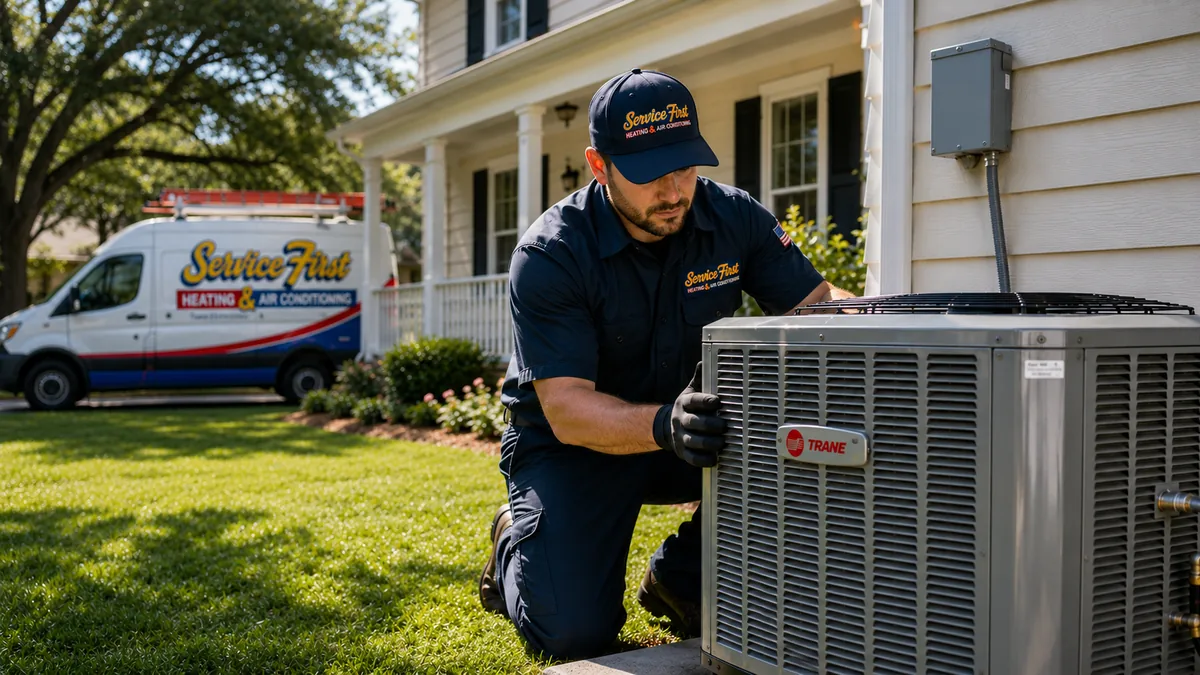
Considering central air conditioning installation in Bucks County? Whether it’s your first central AC, a replacement for an aging unit, or an upgrade from window units, here’s what the process looks like. From the first assessment to the moment your tech walks out the door.
This is what we actually walk homeowners through before we start work.
Is Central Air the Right Call for Your Home?
Central air is the right move for most Bucks County homes, but not all. Older homes without ductwork, additions, or finished spaces sometimes do better with a ductless mini-split. Running new ducts through a 1960s colonial can get expensive and invasive fast.
If you’re not sure, read our side-by-side breakdown: mini-split vs. central air in Bucks County. If you have existing ductwork in decent shape, central air is almost always the more cost-effective long-term choice.
What Actually Happens During a Central Air Installation
Step 1: Load Calculation and System Sizing
Before any equipment is ordered, a legitimate installation starts with a Manual J load calculation. That’s a real assessment of your home’s square footage, insulation quality, window count and orientation, ceiling height, and more. This is how you determine the right system size.
An undersized unit will run constantly and still leave rooms uncomfortable on a 95-degree August day. An oversized unit short-cycles, which causes humidity problems, uneven temperatures, and premature equipment wear. If a contractor hands you a quote without measuring your home, that’s a red flag.
Step 2: Ductwork Assessment
If your home has existing ducts, we inspect them for leaks, blockages, and sizing issues. Leaky ductwork wastes 20 to 30 percent of conditioned air before it ever reaches a room. Putting a new, efficient system on bad ducts defeats the purpose. Our post on common ductwork problems in Bucks County homes covers the most frequent issues we find.
If there’s no existing ductwork, duct routing gets planned at this stage. In older homes, which are common in Doylestown, Yardley, and Richboro, routing can get creative. It’s worth discussing options before the crew shows up on install day.
Step 3: Installation Day
A standard central air installation in a home with existing ductwork typically runs one full day. Homes requiring new ductwork can take two to three days depending on complexity.
Here’s what the crew actually does:
- Outdoor condenser is set on a pad, leveled, and connected to refrigerant lines
- Indoor air handler is installed and tied into the duct system
- Refrigerant lines are run and charged by a licensed technician
- Thermostat is installed and wired (we strongly recommend going smart thermostat at this stage)
- System is tested, airflow is checked at each register, and refrigerant charge is verified
The system will be running before our tech leaves. We don’t call a job done until we’ve confirmed it’s working correctly.
Step 4: What You Need to Do Before Install Day
Clear access to where the indoor air handler will go, typically the basement, attic, or utility closet, and make sure there’s a clear path for refrigerant line runs. The crew handles everything else.
Step 5: What Happens After Install Day
Once your new central air conditioning system is running, the work is not quite done. We register your manufacturer warranty for you the same week. That way, you do not have to track down model numbers months later if something fails. We also schedule a 30-day follow-up check by default. That visit confirms refrigerant levels are holding. We also check for new noises and verify airflow at each register still matches install day.
Step 6: Smart Thermostat Setup and Wi-Fi Pairing
If you chose a smart thermostat at install, our tech pairs it to your Wi-Fi before leaving. We walk you through the homeowner app on your phone. Most modern models take about 15 minutes to set up cleanly. That includes the Trane XL824, the Ecobee Premium, and Honeywell T-series. The biggest first-week mistake is leaving the schedule on a factory setting. We help you build a starting schedule that matches your real day. Then we refine it after the first full week of cooling data.
What Central Air Conditioning Installation Costs in Bucks County
Central air conditioning installation costs in Bucks County depend on several things. System size, efficiency rating, ductwork condition, and job complexity all matter. The range is wide. A rough number won’t mean much without knowing your home.
That said, a few factors swing the bill more than others. A 3-ton or 4-ton system for a larger home runs more than a 2-ton for a smaller one. A higher SEER rating costs more upfront. It also lowers your monthly utility bill for the next 15 years. Existing ductwork in good shape keeps the install simple. New duct runs through finished ceilings can add a full day of labor and material cost.
Use our instant HVAC pricing tool for a real estimate based on your home. The tool covers new system installation costs only. For repair pricing, schedule a diagnostic visit instead so a tech can see the system first.
We also offer financing through Wells Fargo and Synchrony if you would rather spread the cost out. Both run promotional rates throughout the year for qualifying customers.
Permits, Inspections, and What That Means for You
Most Bucks County townships require a permit for a new central air conditioning install. That includes Newtown, Doylestown, Yardley, Richboro, and Langhorne. The permit covers the electrical hookup, the refrigerant line work, and the condensate drain routing.
Service First pulls the permit on your behalf and schedules the township inspection. You do not have to call the township yourself or take time off work for the inspector visit. We coordinate the timing and confirm with you the day before. Most inspections are pass-on-first-try because our techs build to code from the start.
Common Mistakes Bucks County Homeowners Make
A few patterns show up often when you get a bad install. The first is hiring on price alone. The cheapest quote almost always skips the Manual J load calculation. That leads to a wrong-sized system that costs more to run for the next 15 years.
The second is letting an installer talk you into a SEER rating that does not fit your home. Going too high wastes money. Going too low leaves utility savings on the table. You need the SEER that matches your home, your usage, and how long you plan to stay.
The third is skipping the ductwork inspection. A new system on bad ducts will underperform from day one, no matter what you spent on equipment. Always check the ducts first, even if it slows the quote process by a day.
Choosing the Right System
SEER Rating
SEER stands for Seasonal Energy Efficiency Ratio. It measures how efficiently a system cools your home. The federal minimum for our climate zone is SEER 13. Modern high-efficiency units run SEER 18 to 25. A higher SEER means lower monthly bills but a higher upfront cost. In Bucks County, AC runs hard from June through September. A SEER 16 or higher unit typically pays back the extra cost within a few cooling seasons. ENERGY STAR-certified units are a reliable benchmark for efficiency.
Brand and Warranty
We install multiple brands and give honest recommendations based on what holds up in this region long-term. A 10-year parts warranty is standard on most major brands. Ask about both the manufacturer warranty and the contractor’s labor warranty. They’re different things.
How Service First Handles It
We’ve been installing central air across Bucks County since 2009, in Newtown, Doylestown, Yardley, Richboro, Langhorne, and throughout the 58 ZIPs we serve. We do our own load calculations, we assess ductwork honestly (including recommending against central air when a ductless system is the better fit), and we don’t leave until the system is running right.
Ready to start? Check our current specials for active install promotions, or schedule a consultation with our team today. Most Bucks County install jobs can be on the calendar within a week.
Frequently Asked Questions
What should I expect from professional central air conditioning installation in Bucks County?
You can expect a full assessment of your home before any work begins. Your new system will be installed by a professional. You will also get a walkthrough showing you how to operate and maintain your new unit.
How do I know when to call a professional?
If your AC is not cooling well, making strange noises, or breaking down often, call a professional. Unusually high energy bills can also point to a problem with your system.
What's included in a service visit?
A service visit typically includes a full system inspection and filter checks. Your thermostat will be calibrated, and any needed repairs or maintenance will be handled. You will get recommendations for any additional services your system may need.
How much does this service typically cost?
The cost of central air conditioning installation can vary based on factors like the size of your home and the system selected. For a detailed estimate, it’s best to contact a local HVAC service provider.
How often should this service be done?
We size every central air installation in Bucks County from the house. Call 215-876-0486 or schedule an appointment online.